The Unchanging Tradition Is a Story We Tell
Southern traditions change as families and communities carry them into new settings. See how to trace what shifts, what remains, and why it matters.
The most common mistake in talking about Southern tradition is treating a familiar custom as if it arrived intact from the past. That neat story can make living people seem like caretakers of a museum display, and it obscures the choices, disagreements, and adaptations that give a custom its meaning. A tradition is not simply an old act repeated; it is a practice people recognize, explain, and pass along.
That distinction matters whether the subject is a family reunion, a church homecoming, a holiday meal, a dance, or the way neighbors welcome newcomers. The visible gesture may endure while its purpose changes. Or the purpose may remain important while the gesture takes a new form. To understand a custom, look at both what people do and what they say the doing means.
What makes a custom a tradition?
A custom becomes a tradition when a group treats it as connected to shared memory and worthy of continuation. The practice may be repeated regularly, but repetition alone is not enough. People might perform an action out of convenience, habit, or obligation without giving it the weight of inheritance.
Tradition involves interpretation. Someone teaches a child how to prepare a dish, explains why a family gathers after a service, or tells a newcomer what to expect at a community celebration. That explanation can be brief, even unspoken, but it links the present act to a story about belonging, faith, kinship, place, or identity.
There is no single authority who decides what counts. A family may disagree about whether a recipe has changed too much. Members of a congregation may differ on which parts of an annual observance are essential. One person calls a practice sacred; another sees a welcome chance to visit. The disagreement is not proof that tradition has failed. It can show that people are still negotiating what the custom means.
Why does a familiar custom change?
People carry customs into circumstances their predecessors did not face. Relatives move to different towns or states. Work schedules change. A church congregation draws new members. A family grows through marriage, adoption, and friendship. The custom has to meet those circumstances if people want to keep doing it together.
Sometimes the adjustment is practical. A reunion moves from a family home to a park because the group has outgrown the kitchen and yard. Sometimes it is social. A gathering changes its language, music, menu, or invitation practices so people who once felt peripheral can participate. A change may also follow a shift in belief: a custom once defended as proper might be reconsidered when its effects become harder to ignore.
These decisions are rarely tidy. The people who remember an older version may experience change as a loss, while younger relatives may regard the adjustment as the reason the gathering remains welcoming. A useful account makes room for both reactions. It does not assume that the oldest version is the truest one, or that every revision is automatically an improvement.
What stays recognizable when the form shifts?
Often, continuity lies in a purpose rather than a particular object or performance. A meal may move from a church fellowship hall to a rented pavilion, but still provide a place for people to reconnect and share responsibility. A song may be performed with different instruments, while its role in marking a communal moment remains. The setting and materials change; the social work can persist.
But purpose should not be guessed from appearance. A dish served at a gathering may look like an emblem of regional identity to an outside observer. For the people cooking it, the reason might be that an aunt taught the recipe, ingredients are available locally, or everyone knows how to prepare it without instructions. Those ordinary explanations are part of the custom too.
Ask who performs the work, who is invited, who makes decisions, and what participants say they remember. Notice who gets to explain the practice in public and whose version stays within the family. These questions reveal how belonging is organized, not merely how a custom looks in a photograph.
How can you trace a tradition without freezing it?
Start with a specific practice rather than a broad claim such as “Southern hospitality” or “the old way.” Broad labels turn many distinct customs into a single regional personality. Choose something observable: a reunion meal, a church homecoming, a neighborhood fish fry, a holiday visit, or a local music gathering.
- Describe the current practice. Record what happens, where it happens, who takes part, and what people contribute. Keep observation separate from interpretation.
- Ask how participants explain it. A longtime member, a new participant, and someone who no longer attends may describe different meanings. Each perspective can clarify a different part of the story.
- Compare accounts across generations. Ask what people remember changing, what they miss, and what they are glad to have changed. Treat memory as testimony, not as a complete record.
- Look for quiet revisions. Invitations, accessibility, language, scheduling, food, and the division of labor can shift without changing the event’s name.
- Notice who is absent. Ask whether cost, distance, conflict, work, disability, or social expectations affect participation. A custom’s public image may not show who cannot join.
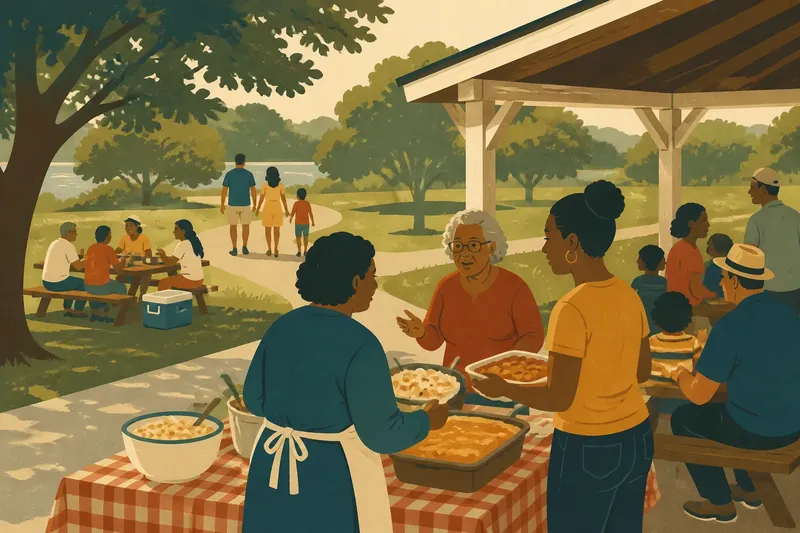
Imagine a family whose annual reunion has always been described as a Sunday dinner at the oldest sibling’s home. After relatives move farther away, the gathering becomes a Saturday picnic at a county park. One cousin brings the familiar casserole, another organizes a shared ride, and younger relatives invite friends who have become part of the family’s life. The observable result is not simply a new venue: more people can attend, the cooking is shared, and the family’s account of what makes the reunion “the same” becomes clearer. Some may still miss the house. That feeling belongs in the history rather than being edited out.
What questions help distinguish continuity from nostalgia?
How do you know a custom is still the same tradition?
There is no universal test, because participants decide what connection matters to them. Ask what they believe is being carried forward, and compare that answer with the practice’s actual history and present effects.
Does changing a custom mean losing it?
Not necessarily. A change can preserve a custom’s purpose when the old form no longer works for the group. It can also alter the purpose, which is worth naming rather than disguising as simple continuity.
Whose account of a tradition should you trust?
Listen to people with different relationships to the practice, including organizers, participants, and those who have stepped away. No single account has to settle every disagreement, but leaving out affected voices makes the story less complete.
Why do people describe traditions as unchanging?
The phrase can express affection, loyalty, or a wish to protect a valued practice. It can also lend authority to one version and make other participants’ changes seem illegitimate.
When does a tradition become a public claim?
A custom’s meaning can change again when it moves from private or local life into public display. A festival, tourism brochure, school program, or heritage event may present a practice as a symbol of the whole region. That presentation can help people recognize a local history, but it may flatten disagreements and make a varied custom look uniform.
Pay attention to who is doing the presenting and who benefits from the version on display. A festival may feature a community’s food or music while giving little space to the people who sustain it year-round. A school lesson may honor a familiar custom but omit participants who have questioned its rules. Public recognition and public simplification can arrive together.
That does not make a public version false by definition. It makes it one setting among several. The same event can feel intimate at a family table, communal at a church gathering, and representative when staged for visitors. Each setting selects details and gives them a different audience.
What does careful storytelling leave unresolved?
A careful account does not force everyone into agreement about what a custom means. It records the practice, the reasons people give for keeping or changing it, and the uneven effects of those choices. If participants remember different versions, that difference is evidence about how memory and belonging work, not a nuisance to smooth away.
The phrase “unchanging tradition” can be useful as a clue. It points toward something people value enough to describe as enduring. The next question is what, exactly, they want to endure: a recipe, a gathering, a relationship, a claim to place, a religious obligation, or a way of recognizing one another.
When you hear a Southern tradition called timeless, ask who is carrying it now and what they have had to alter to keep carrying it. That question respects continuity without mistaking it for stillness, and it leaves room for the people inside the custom to tell more than one version of its story.