Brick, Wood or Stone: Reading a Building's Material Choices
Brick, wood or stone can reveal how a Southern facade meets climate and craft; learn what each material suggests without mistaking it for proof of origin.
The common mistake when reading a Southern building is to treat its brick, wood, or stone as a birthplace label. That shortcut can turn a useful clue into a false story: local materials and familiar building traditions travel, while buildings are repaired, expanded, and reclad. A facade is better read as a set of choices shaped by weather, supply, skill, and use.
Start with the question that matters most: what problem was this material solving here? Brick may have suited a town with nearby clay and established masons. Wood may have answered a need for adaptable framing and broad, shaded porches. Stone may reflect local geology, a durable foundation, or an owner's preference. None, by itself, identifies where a building began.
What does brick suggest in a Southern facade?
Brick is a strong clue to a region's building economy, not a deed with an address on it. In parts of the South, clay was available nearby, and brickmaking and masonry skills became part of local construction. In other places, brick could be brought in by rail or boat. A brick facade might be structural, or it might be a veneer over another wall system.
Look at the whole face, not just its color. Bond patterns, mortar joints, lintels above openings, and the way corners are finished can hint at how the wall was built. A uniform surface may reflect later replacement or a veneer; irregular bricks and varied mortar can point to different work phases. These clues need context, since repointing and patching can change the appearance.
Brick often suits a facade expected to take daily wear, but it still responds to moisture and heat. Deep shade, damp ground, and poor drainage can leave marks or weaken mortar. The practical fit is strongest where brick was available, skilled labor was accessible, and the wall could be maintained with compatible materials.
When is wood the better clue?
Wood often tells more about framing and shade than about regional identity. It can be cut, assembled, repaired, and extended with relative flexibility, making it useful where timber and carpentry skills were at hand. In a Southern town, a wood facade may include a porch or projecting eaves that temper sun and rain. Those features reflect choices about comfort and use as much as a local style.
Wood needs attention to moisture, insects, and exposure. Paint and siding can conceal older layers, and replacement boards may not match the original species or profile. Check where boards meet trim, how the porch joins the main wall, and whether the finish changes across an addition. A sharp seam can mark a repair or alteration, not a different origin.
Wood fits a reader's interpretation best when the building shows a coherent carpentry system and the surrounding landscape once supplied usable timber. Even then, lumber moved through trade, and builders carried techniques with them. A familiar board pattern is evidence of a method, not a map pin.
What can stone tell you?
Stone makes local geology tempting to read, and sometimes the connection is plain: a foundation or wall uses material found in the surrounding area. But stone could also be hauled from a quarry elsewhere, selected for appearance, or used only where strength and ground contact mattered. A stone base beneath a wood upper story may be a practical division of labor between materials.
Notice whether the stone is cut into regular blocks, laid as rough rubble, or used as trim around doors and windows. The joints, tool marks, and relationship to the rest of the wall help distinguish a structural wall from a decorative surface. Mortar color can also change after repairs, so a neat, consistent joint is not automatically original.
Stone is a good fit for reading the meeting point between site and building. It may tell you what was available, what a builder wanted to protect, or what an owner could afford to bring in. It cannot establish that the structure has always stood where it does now.
Which material fits the question you have?
How do I tell if brick is structural or veneer?
Inspect visible edges at openings, corners, and unfinished or exposed areas, if you can do so without disturbing the building. Wall depth, bond pattern, and how the brick meets adjacent materials may offer clues, but a facade view alone can leave the construction uncertain.
Does a wood porch mean the building was designed for the South?
A porch can respond to sun, rain, and outdoor social life, but porches appear in many regions and periods. Read its depth, roof, orientation, and connection to the house alongside the building's other features rather than treating it as a regional signature.
Can local stone identify a building's original location?
It can suggest a relationship to nearby geology, especially when the stone resembles material used in surrounding structures. Trade, reuse, and later additions complicate that reading, so stone is a clue to supply and construction rather than proof of origin.
Which clues matter most when materials have been replaced?
Look for transitions: changes in mortar, siding profile, stone finish, or the way an addition meets the older wall. A replacement can preserve the original form while changing the material, so the surviving joinery and layout may be more revealing than the surface.
How should you read a mixed-material facade?
Most useful readings sort the evidence by the question at hand. If you want to understand climate, notice eaves, porches, openings, and how surfaces meet rain and sun. If you want to understand supply, compare the facade with nearby materials and local building patterns. If you want to understand change, pay attention to seams and mismatched finishes.
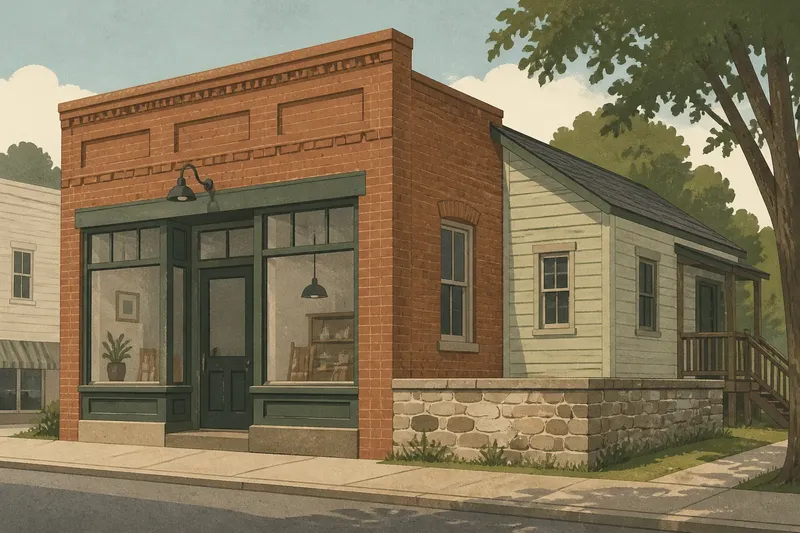
Say you are looking at an invented small-town storefront with a brick front, a wood rear addition, and a stone foundation. You might first record that the materials change at the rear wall and where the foundation meets the facade. That observation could support a cautious reading: the storefront may have been altered or built in phases. It would not establish when, by whom, or where its materials came from.
For a useful field note, describe what you can see before naming a style or origin. Record the material, its location on the building, the condition of joints, and any visible transition. Compare those details with nearby buildings, but keep differences as evidence rather than forcing them into a single regional story.
Brick, wood, or stone can each fit a Southern facade for different reasons: supply, weather, craft, or later change. The best reading leaves room for all four. If you want to identify a building's origin, treat material as one clue among many and look for documentary or architectural evidence beyond the wall itself.