A Town-Square Walk for Noticing Public Memory
A town-square walk for noticing public memory helps first-time visitors read names, plaques and gathering spaces—and see whose stories the square leaves out.
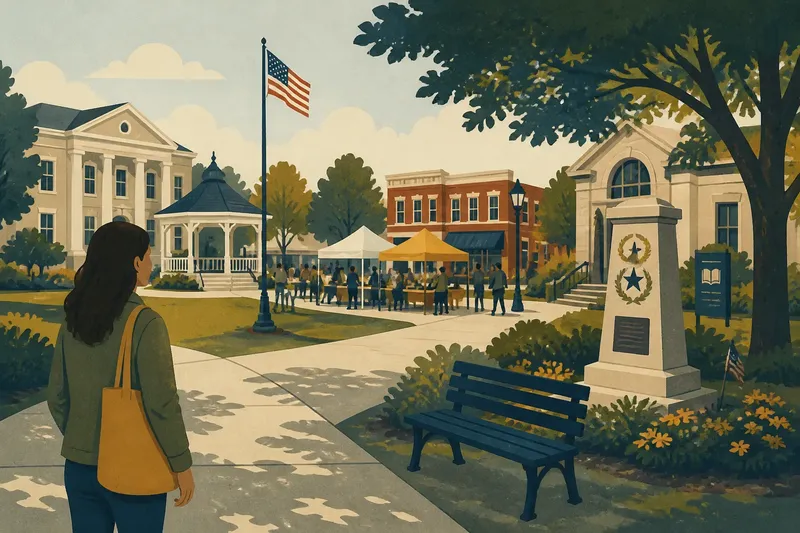
The common mistake on a first town-square visit is to treat the monuments as the whole story. A town-square walk for noticing public memory can reveal more: who gets named, where people are invited to gather, and which histories remain hard to see. That reading takes attention, not a guidebook or a theory of architecture. Start at an ordinary entrance and let the square’s choices set the route.
1. Begin at the entrance people actually use
Choose the approach that seems most practical: a sidewalk from a nearby shop, a path from a parking area, or a crossing from a bus stop. A formal gateway may look important, but the route people use in daily life can tell you more about how the square fits into town routines.
Notice what greets you first. It might be a welcome sign, a memorial, a flagpole, a set of steps, or a broad patch of open pavement. Ask what a visitor learns before reaching the center. Does the entrance identify the place, commemorate someone, direct people toward an event space, or simply let them pass through?
Also note whether the entrance is legible to someone who has not been here before. Signs, paths and visible landmarks can make a public place feel open; a confusing edge can make it seem intended for people who already know where to go. That is an observation about the space, not a verdict on the people in it.
2. Read names as choices, not decorations
Names appear on street signs, building fronts, plaques, benches and monuments. Record a few mentally, along with where they appear. Are they surnames, military titles, civic offices, local businesses, Indigenous place names, or references to an event? The pattern can show which kinds of contribution the square considers worth remembering.
Look for repetition. A single prominent surname may be one dedication; the same family name on several buildings or signs suggests a broader civic presence. Conversely, a name may appear only in small lettering at the edge of a larger display. Position and scale affect what a hurried visitor is likely to notice.
Names alone do not disclose a person’s full history, and a plaque’s wording is not a complete account. Treat the inscription as evidence of what the public display chooses to say. If the name is unfamiliar, note it for later rather than guessing from the title or date nearby.
3. Give plaques enough time to become readable
A plaque invites close attention, but its wording can be partial, ceremonial or difficult to read. Stand where the text is visible without blocking a path. Notice who or what it commemorates, the verbs it uses, and whether it gives any context beyond a name and an honorific.
Words such as “settled,” “served,” “founded” or “preserved” describe different kinds of public memory. They may make conflict, displacement or disagreement less visible, even without saying anything plainly false. Ask what the text includes, then what kind of information would help explain the claim. A nearby historical marker, local archive or public library may offer a fuller account.
Check whether the plaque has a date of installation or a sponsoring organization. Such details can help distinguish the event being remembered from the later decision to commemorate it. Those are separate moments, and the choice to add a marker belongs to the square’s history too.
4. Follow the routes between memorials and everyday stops
Walk from a marker to a place where people might sit, wait, eat lunch or meet someone. The connection matters. A memorial at the center of a clear path receives a different kind of attention from one tucked behind a hedge or beside a service entrance.
Notice whether routes encourage visitors to approach, pause and read, or whether they carry people past without much room to stop. Benches, shade, steps and nearby sidewalks can shape how long someone stays. A square can honor a person in stone while making the practical act of gathering around that tribute awkward.
Look for signs of ordinary use without turning anyone into a specimen. People may be crossing to a store, talking on a bench or setting up for an event. Their presence shows that public memory shares space with daily life. It does not authorize conclusions about who belongs there or what they think of a monument.
5. Notice who can gather, and where
Squares often contain several distinct gathering spaces: a lawn, a bandstand, a courthouse-facing platform, a shaded corner or a strip of tables near food businesses. Ask which spaces appear designed for formal ceremonies and which accommodate informal use. Their arrangement can tell you how the place balances civic display with everyday company.
Observe the available seating and the way it is oriented. Benches facing a monument invite a different kind of pause from seats gathered around a central table. A wide paved area may suit a parade or public address, while a smaller shaded area may support conversation. These features offer possibilities, not proof of how the square is used.
Imagine you arrive while a small craft market is being set up in the open center. You see a veterans’ marker beside the main path, a shaded bench near the edge, and a narrow route between vendor tables and a library entrance. You might note that official commemoration and neighborhood activity occupy the same square, while the best-known monument is easier to approach than the quieter seating. That is a useful first-visit observation; it does not establish who planned the market or how local residents feel about the marker.
6. Search for histories that are present but less prominent
Scan for names and stories that do not occupy the largest monument. They may appear on a small interpretive sign, a community mural, a building directory, a public art label or a notice about an annual gathering. These traces can point toward groups whose histories are acknowledged in the square but given less space or less formal language.
Do not assume that an absent name means a community has no connection to the place. Public markers are selective, and some histories may be preserved in oral accounts, local collections or nearby institutions rather than on the central lawn. A respectful next question is where those accounts are kept and who has authority to tell them.
Pay attention to language as well as visibility. A place name in a language other than English, for example, may be printed prominently, translated, or left unexplained. Record what the sign actually says. Avoid turning a brief inscription into a claim about the whole community’s history.
7. What should you ask before drawing a conclusion?
Does a prominent monument represent the whole town?
No single marker can stand in for a town’s many histories. Treat it as evidence of one public choice, then compare it with names, routes and gathering spaces elsewhere in the square.
What if a plaque is worn or unreadable?
Note its location and any visible sponsor or date, but do not fill gaps by guessing. A library, historical society or municipal archive may have a transcription or records about the dedication.
Can people’s behavior explain what a monument means to them?
Not reliably from a brief visit. You can describe observable activity, such as people passing or sitting nearby, but personal meaning is better learned from people who choose to share it.
How can a visitor follow up without treating the square as a puzzle?
Use a public library, local museum, town archive or official heritage resource to check names and dates. If you speak with residents, ask open questions and accept that they may not want to explain a place to a stranger.
8. Leave with a question that can be checked
Before leaving, identify one specific gap or uncertainty. Perhaps a plaque names a person without describing their role, or a sign uses a local place name without translation. A narrow question is more useful than deciding the square is simply inclusive or exclusionary. It gives you something concrete to verify.
Keep your notes descriptive: the wording, position, route and nearby uses. Separate what you saw from what you inferred. That distinction makes a town-square walk for noticing public memory more careful and more useful. The square may not explain its choices on the spot, but it can show where to look next: a public record, a local collection, or a conversation with someone whose connection to the place is deeper than a first visit.